
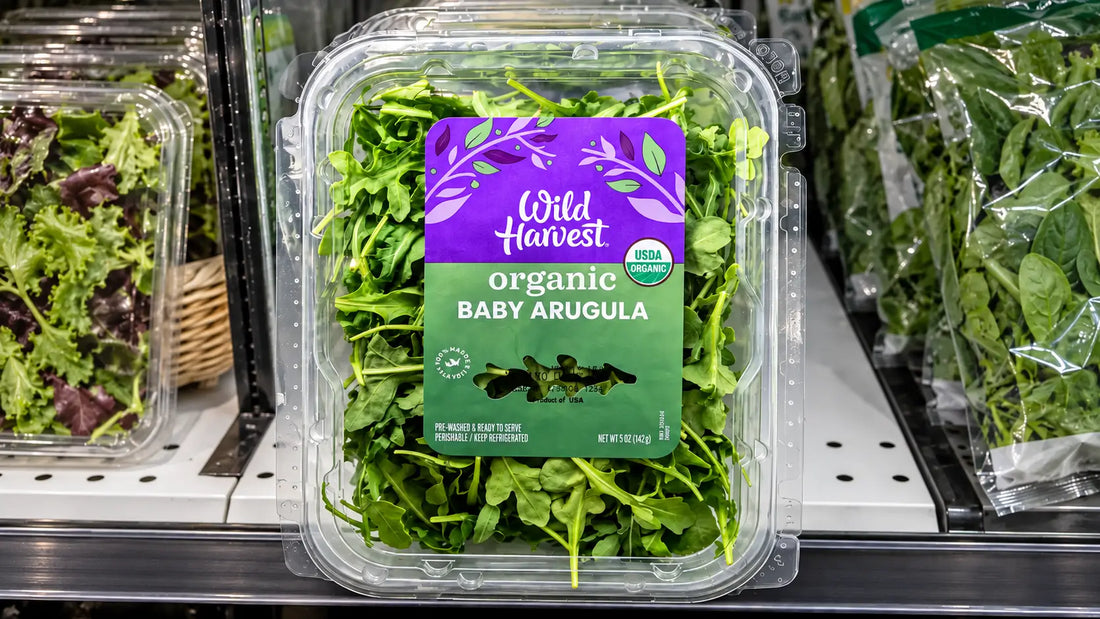
Organic apples cost more. Everyone knows it, and most of us have stood in a produce aisle doing the math: is the extra dollar a pound buying anything, or just a sticker?
You'd expect a health food store to say “always buy organic.” We're not going to. The honest answer is that organic is worth it for some foods and not for others, and the difference is easy to learn.
So here's what the USDA label actually requires, what the research does and doesn't show, where organic matters most, and how we think about it when we're choosing what to put on our own shelves in Canton.
What “organic” actually means
“Organic” isn't a vibe. In the U.S. it's a legal term, run by the USDA's National Organic Program, and a farm has to earn it. In plain terms, certified organic means:
- No synthetic pesticides or fertilizers, with a short list of approved exceptions.
- No genetically engineered ingredients, sewage sludge, or irradiation.
- The land has to be clear of prohibited substances for three years before crops can be called organic.
- An accredited certifier inspects the operation every year.
Packaged foods play by the same rules. If at least 95% of the ingredients, not counting salt and water, are organic, the product can wear the USDA organic seal. At 70% or more, it can say “made with organic” and name up to three ingredients, but it can't carry the seal or call itself organic.
Here's the detail that matters most in a place like the North Country: farms selling $5,000 or less a year in organic products don't have to get certified. They still have to follow the organic rules, but they can't use the USDA seal or call themselves “certified organic.”
Certification costs money and takes paperwork, and for a very small farm that can be the whole margin. So some of the growers you'll meet around here farm to organic standards without ever having the sticker.
And three things organic does not mean: it doesn't mean pesticide-free, it doesn't mean local, and it doesn't automatically mean more nutritious. Those are separate questions.
Does organic food have more nutrients?
Mostly no. A little, in some cases. Not enough to be the reason you buy it.
Scientists have been asking this question for a long time, and the big reviews keep landing in roughly the same place.
In 2012, a Stanford University team reviewed more than 200 studies and found no strong evidence that organic foods are significantly more nutritious than conventional foods.
In 2014, a larger analysis led by Newcastle University covering 343 studies did find some differences: organic crops had higher levels of certain antioxidants and lower levels of cadmium.
Newer work points in a similar direction. A 2024 review of 147 studies found no across-the-board nutritional advantage for organic. A 2025 review found organic fruit and vegetables slightly higher in some polyphenols, vitamin C, and minerals, but couldn't show that this translates into better health.
Organic isn't a vitamin upgrade. If nutrition is your only reason for paying more, keep the money and buy more vegetables instead.
Where organic clearly makes a difference: pesticide residue
This is the part where the evidence becomes more consistent. The Stanford review found organic produce was less likely to carry detectable pesticide residue than conventional produce, while the Newcastle analysis also found substantially more residue in conventional crops.
It's also fair to say the other side plainly. The USDA tests thousands of conventional food samples through its Pesticide Data Program, and in the 2024 data published in 2026, more than 99% of samples were below the EPA's established safety limits.
Conventional produce isn't therefore automatically unsafe. But “below the limit” isn't the same thing as “nothing on it.” The practical question is whether you want to reduce residue exposure, and for some foods that is easier to do than for others.
The foods where it matters most
Every spring, the Environmental Working Group uses USDA residue data to sort produce into the Dirty Dozen and the Clean Fifteen. The pattern is familiar: thin-skinned produce and leafy greens tend to show up higher, while foods with peels, shells, or husks tend to show up lower.

Buy organic first
Prioritize Dirty Dozen produce — especially berries, leafy greens,
and other items where residue tends to be more common.
Conventional is often fine
Clean Fifteen produce is generally a lower priority for spending
extra on organic.
Whichever you buy, rinse fresh produce under running water before eating. The FDA recommends washing fresh produce whether it's organic or conventional.
Where organic matters less
- Anything you peel. Bananas, oranges, avocados, and onions are lower priorities because the outer layer is removed before eating.
- Processed organic snacks. Organic cookies are still cookies. The seal tells you something about how the ingredients were produced, not whether the finished snack is nutritious.
- Nutrition claims. If you're paying more purely because you expect significantly more vitamins, the research doesn't strongly support that reason.
What organic costs — and why

Organic usually costs more. Certification fees, lower yields on some crops, more hand labor for weeds and pests, and smaller supply chains all add up.
How much more depends on the item. USDA economists have found organic premiums ranging from relatively small differences to substantially higher prices in some categories.
Two ways to buy organic without doubling your bill:
- Prioritize. Buy organic for higher-residue produce and the foods you eat most; use conventional options for lower-priority items.
- Buy in season and buy bulk. Local organic produce is usually most affordable when farms have the greatest supply. Bulk grains, beans, and nuts can also reduce packaging costs.
Local vs. organic: they're not the same thing
“Local” tells you where food came from. “Organic” tells you about how it was produced. Sometimes you get both, but one doesn't automatically mean the other.
| Certified organic | Local | Local + certified organic | |
|---|---|---|---|
| What it guarantees | Grown to USDA organic standards and inspected through the certification process. | Grown nearby, usually within the county or surrounding region. | Both. |
| What it doesn't tell you | Where it came from or how far it travelled. | Certification status. Some local farms use organic or earth-friendly methods without certification. | Very little is left unanswered about location and certification. |
| Freshness | Varies; products may have travelled considerable distances. | Often delivered relatively soon after harvest. | Similar freshness advantages to other local produce. |
| Who you're supporting | A certified farm, wherever it's located. | A nearby farmer or producer. | A nearby farmer who is also certified organic. |
| Typical cost | Usually higher. | Often somewhere in the middle. | Usually higher. |
How we decide what to stock
We don't have a rule that says everything on the shelf must be organic, and we're not going to pretend we do.
What we look for is produce that's certified organic, grown locally, grown by farms using organic or earth-friendly practices, or ideally both. And when it's in season, local comes first.
The farms and producers we work with are all listed on our supplier page.
Frequently asked questions
Is organic food healthier?
Not necessarily in nutrients. The strongest consistent difference is lower pesticide residue. Whether that's worth the price depends on the food and your priorities.
Is organic worth it on a budget?
For some foods, yes. Prioritize thin-skinned produce and leafy greens, and consider conventional options for produce you peel.
Does organic mean pesticide-free?
No. Organic farming can use approved pesticides. The organic standard restricts which substances and production methods are allowed.
Is local food organic?
Not always. “Local” is about where food comes from; “organic” is about how it's grown. Some small farms use organic methods without becoming certified.
Which fruits and vegetables should I buy organic?
A practical place to start is higher-residue produce such as leafy greens, berries, grapes, peaches, apples, pears, and similar items.
Where can I buy organic groceries in Canton, NY?
Nature's Storehouse is at 21 Main Street in Canton. We carry certified-organic, natural, and locally grown products across produce, bulk, pantry, and refrigerated departments.
Our honest answer
For produce that tends to carry more residue, organic can be worth it. For anyone who wants to reduce synthetic pesticide use on principle, it can be worth it. And if buying organic helps support farms whose growing methods you value, that's another reason.
As a vitamin upgrade? No. And organic cookies are still cookies.
Put the money where it counts: the foods you eat every day, the produce where organic makes the clearest difference, and the local farms — certified or not — whose methods you trust.
That's how we shop. It's what we'd tell anyone standing in our aisle with an apple in each hand, trying to decide.
That's how we shop. If you want to see it in practice, the Dirty Dozen is organic on our shelf, and the local farms are named on the sign.
Plan your visit
Nature's Storehouse
21 Main Street, Canton, NY 13617
